
Lorem ipsum dolor sit amet, consectetur adipiscing elit.


(Excerpt) CIVIL WAR (1861-1865)
The first use of electricity by the United States during a time of war wasn’t through transmission lines, but rather the lines used for electrical telegraph. When the war started in April 1861, the Union already saw the importance of telegraph communication. It allowed President Abraham Lincoln and his administration to receive messages about the war and send responses quicker than messengers.
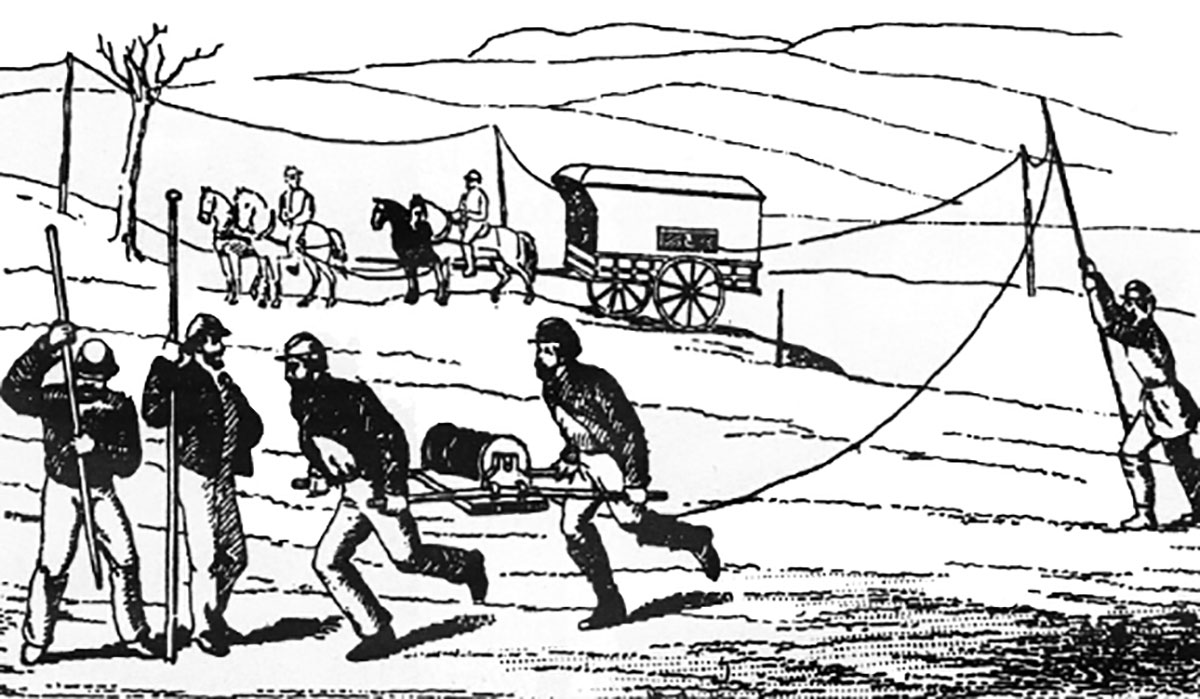
The military formed the U.S. Military Telegraph Corps to handle the task of establishing telegraph lines to the battlefields. The members of the corps were not soldiers, but civilians who placed themselves in great danger to help with the war effort. Those who went out to set up the lines of communication had one of the most dangerous jobs in the nation. Corps linemen were under constant threat of capture, injury, or death at the hands of the Confederate Army. Linemen and operators had a death rate of 1 in 10 during the Civil War, which was about the same rate for soldiers.
During the course of the Civil War and for about one year after, the USMTC laid a total of 15,400 miles of telegraph cable. 8,000 miles of that was for military use and a lot of it was laid in the middle of battles. Because the corps members weren’t military, their families received no benefits after death. No Corps member was eligible for a pension, and they didn’t receive any recognition for their service and bravery until 32 years after the war ended.

At the time of the Civil War, as noted in the excerpt, electricity was used to power the electric telegraph, which was somewhat like a telephone. It was developed in the 1840s and allowed messages in the form of a coded signal to be sent over long distances.
An understanding of circuits is key to your comprehension of the functioning of the telegraph, a key technology used during the Civil War. The remainder of this lesson contains resources and guiding questions to assist you in understanding and ultimately creating your own telegraph machine. Taking time to use what you have read to answer the question will help you monitor your own learning and ensure your own understanding.
Please go to the original websites or research further sources to find additional information to inform your understanding of the telegraph machine.

Read pages 1-5 of the linked article which explains circuits. How Circuits Work
Answer the following questions:

The article you read on the prior slide introduced you to the concept of circuits. The next two slides explain how circuit theory is applied in the function of a telegraph. As you examine the diagram and read the text, identify the parts of the telegraph that perform specific circuit functions. For example, identify the energy source of the telegraph; identify the piece that is used to open and close the circuit. The idea is to match what you have learned to the functioning of the circuit.


Local Sounder- The "sounder" is the receiving instrument. This instrument is designed to produce an audible "click" when its electromagnet is energized. It also produces a second "click" with a slightly different tone upon cessation of the current. Thus each current pulse produces a "click-clack" sound. The local sounder is designed for maximum loudness, and it is not very sensitive to electrical current. It takes as much as 20 times as much current to activate a local sounder compared to a relay.
Main Battery- This is a battery made of several electrochemical cells connected in series. Up to several hundred volts may be required depending on the length of the line and the number of instruments cut into the wire. These batteries were replaced with dynamos somewhere around the turn of the century.

Local Battery- This was usually a single cell with a voltage of 1 to 1.5 volts. Its only purpose was as a current source for the local sounder. The local battery continued in use well into the 20th century in the many depots and way stations without AC power.
Telegraph Line- Usually a very heavy iron wire was used. The wire was galvanized to reduce corrosion. The telegraph line was suspended from wooden poles using specially designed glass insulators. The design of the insulators was critical in reducing leakage paths to ground. These leakage paths were known as "escapes", and they could render a telegraph line useless in wet weather.

Now that you have learned about the basics of circuits and read about how circuit theory is applied to the telegraph, you are ready to try to implement what you have learned.
To build the telegraph as explained in the video below, you will need the following items:
Watch the video below and try to build a telegraph yourself. How to Build a Telegraph: How To Build a Telegraph


