
Lorem ipsum dolor sit amet, consectetur adipiscing elit.

Mathematical Decision Making/ Finance

Kids Explains Stock Market in One Minute
Before the Great Depression, banks were used by people who believed they were storing their money in a secure institution. However, banks did not hold people’s money physically. Banks lent out depositors’ money to those who wanted to buy homes. Also, prior to the Banking Act of 1933, banks also invested depositors’ money in the stock market.
Individual investors also invested in the stock market. Some invested their entire savings while others borrowed money to invest.

The following short video explains how people’s investment patterns and movements in the stock market led to the Great Depression:
The 1929 Stock Market Crash - Black Thursday - Extra History
During the video, take notes answering the following question:

As the stock market crashed, banks demanded repayment from those who had bought stocks “on the margin.” How was the wider economy affected when individuals could not pay back the bank loans?
What is the reasoning behind the assertion that the stock market and economy are not the same?
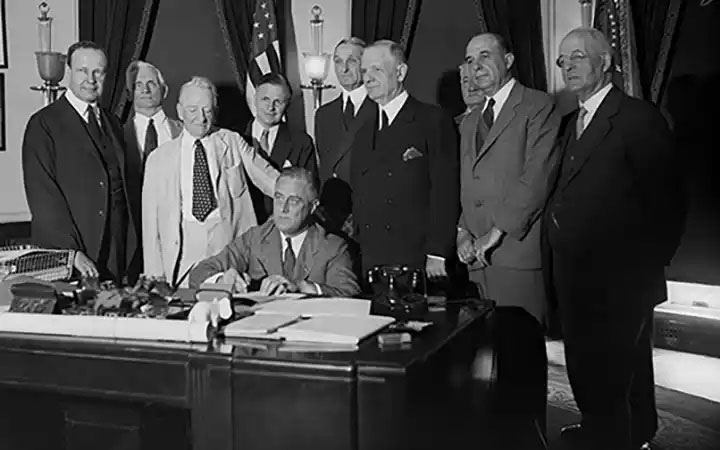
Banking Act of 1933 (Glass-Steagall) | Federal Reserve History
The Banking Act of 1933 made several corrections to how banks operated for the purpose of protecting consumers. (Please read the article linked in the title for details.) One important correction was the separation of commercial banks from investment banks. This separation means that banks cannot use the money people deposit to invest in the stock market. It also means that people cannot borrow money from a commercial bank for the purpose of investing in the stock market. Instead, investment banks specialize in investing which means investment bank depositors deposit their money understanding the risk related to doing business. They have the expectation that the money they deposit is being invested in various ways and is not simply sitting in safe keeping for whenever they wish to withdraw it.

Another important correction made by the Banking Act of 1933 was FDIC insurance. FDIC requires banks to keep a certain amount of cash available in reserve for when customers wish to withdraw from their deposits. Additionally, customer deposits are insured up to a certain dollar amount if the bank fails or closes. In 1933, deposits were insured up to $2500. Today, deposits are insured up to $250,000.

Watch current financial news reports or read current financial articles from various media companies. Are there any indications that the current economy might be in danger of a financial depression?
If you wanted to avoid personal loss during a financial depression, what steps would you take?

EPF.1 The student will demonstrate basic economic concepts and structures by a)explaining that choices often have long-term unintended consequences.
EPF.3 The student will demonstrate knowledge of how monetary and fiscal policy influence employment, output, and prices by a) describing the purpose, structure, and function of the Federal Reserve System.
EPF.12 The student will demonstrate knowledge of banking transactions by h) explaining how certain historical events have influenced the banking system and other financial institutions.